
AI Video Ad Analysis: What Chorus Analysis Reports Actually Show (With Real Example)
When we talk to video marketers about their pre-launch process, a common pattern emerges: they have creative instincts, but no structured way to validate them before spend. Video producers tell us they’ll review a cut and think “something’s off at the 45-second mark” but can’t articulate why. They don’t have time to gather ten opinions before the campaign deadline, and even when they do, those opinions often contradict each other.
We built Analysis because we kept hearing this same pain point: marketers with good instincts but no structured way to validate them before launch. That’s the gap Analysis is designed to fill—not more opinions, but expert review that gives you language for what your gut already suspects.
TL;DR
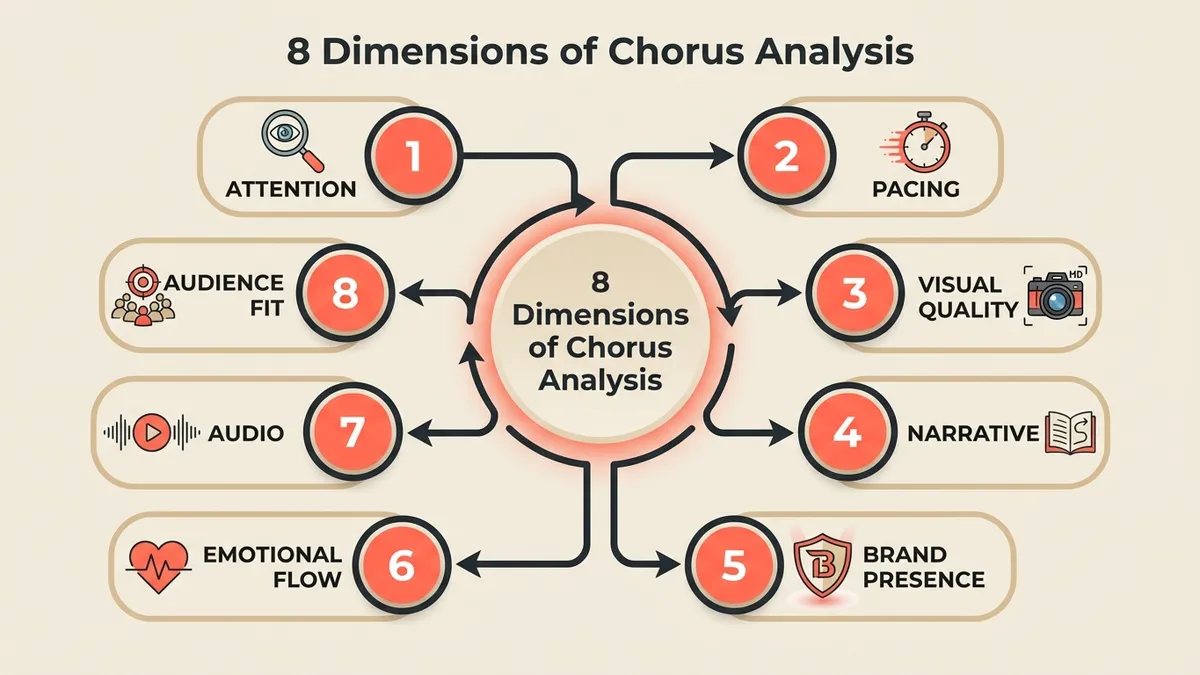
Analysis is Chorus’s expert AI review of your creative—a comprehensive breakdown across 8 dimensions: attention, pacing, visual quality, narrative structure, brand presence, emotional flow, audio alignment, and audience fit. Unlike Quick Check (persona scoring) or Focus Group (simulated discussion), Analysis examines your content through professional marketing and advertising lenses.
Here’s what a real video ad analysis looks like, using a Coinbase Super Bowl ad as the example. See the full report or book a demo to see Analysis on your own creative.
What Analysis actually is
Marketers told us they needed something different from persona scores or simulated discussions. They wanted a “senior strategist” review—someone who could look at their creative and tell them exactly what was working and what wasn’t, with evidence. In industry terms, this is closest to an AI creative audit or ad effectiveness analysis. (See our glossary for how these terms compare.)
Analysis is our answer. While Quick Check asks “how do different audience segments score this?” (AI creative scoring) and Focus Group asks “what would people say about this in a room together?” (synthetic focus groups), Analysis asks a different question entirely: What’s the technical quality and strategic effectiveness of this creative?
Think of it like psychohistory from Asimov’s Foundation—predictive patterns at scale, applied to your video ad. Analysis breaks down what’s working, what’s missing, and why certain moments succeed or fail. The output isn’t scores or discussion; it’s structured diagnosis.
How AI Video Analysis Works (And How It Compares to System1)
If you’ve researched AI video analysis or video ad testing, you’ve likely encountered System1—the market leader in emotion-based ad testing. Teams often ask us how Analysis compares.
| Dimension | System1 Test Your Ad | Chorus Analysis |
|---|---|---|
| Approach | Emotion measurement (facial coding, surveys) | Structural analysis (8 dimensions) |
| Output | Star rating (1-5.9), emotional response curve | Detailed breakdown, prioritized recommendations |
| Data source | Real human panel viewing ads | AI analysis of creative elements |
| Speed | Days (requires panel recruitment) | Minutes |
| Best for | Predicting market-level ad performance | Diagnosing specific structural issues |
| Qualitative depth | Limited—primarily emotion scores | High—explains why each element works |
When to choose System1: You need to predict how an ad will perform in-market against their normative database. Their star rating system is industry-standard for forecasting TV ad success.
When to choose Analysis: You need to understand why something works or doesn’t—specific issues with pacing, brand presence, narrative arc, audio alignment. Analysis tells you what to fix; System1 tells you whether it’ll probably work.
Complementary use: Some teams use both—Analysis to diagnose and iterate during production, System1 for final validation before major media spend. Analysis is the doctor who explains the problem; System1 is the test that confirms you’re healthy.
The anatomy of a video ad report
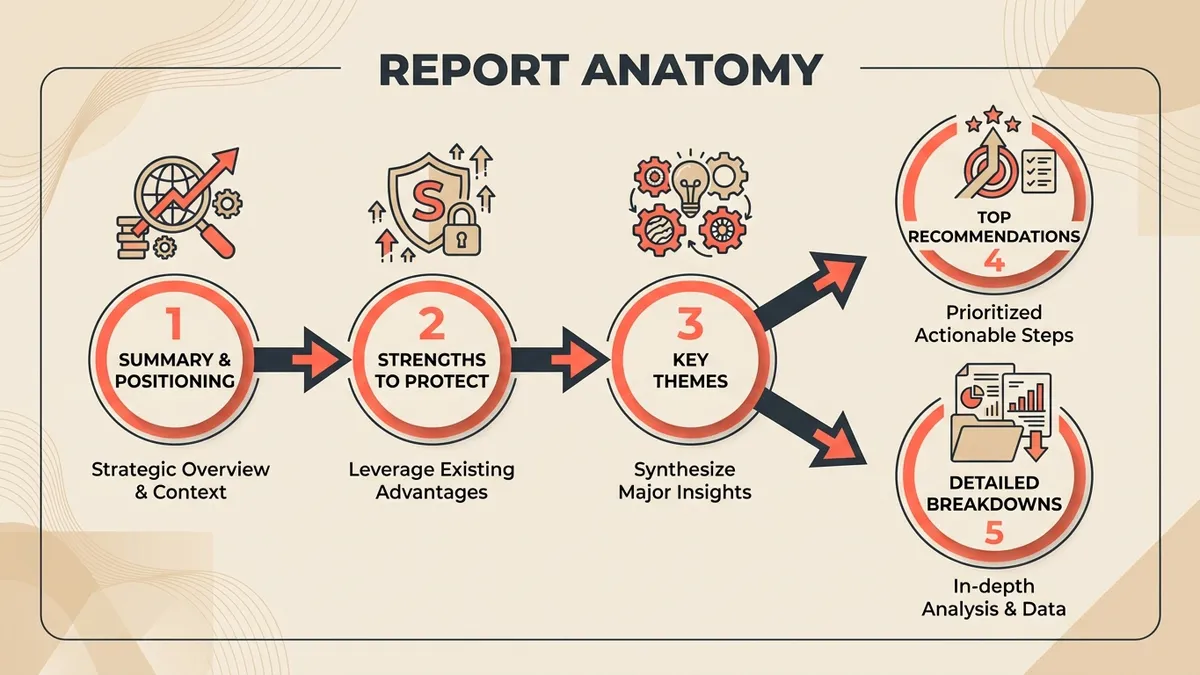
Let’s walk through what an Analysis report contains, using a real Coinbase video ad we ran through Chorus. This was a Super Bowl-style brand awareness spot using musical theater satire to address economic frustrations.
Summary and positioning
Every report starts with a one-paragraph summary and positioning statement:
Positioning: Coinbase as the agent of change for a broken financial system. Primary Message: The current economic reality is unacceptable; don’t accept the status quo.
The summary gives you the “elevator pitch” of what the creative is actually saying—useful for alignment conversations with stakeholders who haven’t watched the full video yet. It also surfaces the strategic intent, so you can verify whether your creative is landing where you aimed it.
Strengths (what to protect)
Analysis identifies what’s working and should be preserved:
- High-impact creative concept — Musical satire addresses serious economic pain points
- Exceptional production value — Cinematic choreography and set design
- Strong cultural resonance — Targets “cost of living crisis” sentiment without being depressing
- Distinctive differentiation — Breaks from typical crypto advertising
- Viral potential — Relatability and entertainment value with catchy, ironic lyrics
This section answers the question stakeholders inevitably ask: “What should we definitely NOT change?” When you’re iterating, knowing what to protect is just as important as knowing what to fix.
Key themes
The report surfaces dominant themes that emerged across the analysis:
Inflation/Cost of Living, Broken Financial System, Housing Crisis, Corporate Disillusionment, Irony
Themes help you understand what your creative is really about from an audience perspective—which sometimes differs from what the brief said it was about.
Top recommendations (prioritized)
Here’s where the report earns its rent. Instead of a pile of suggestions, you get ranked recommendations with priority levels:
- Create Vertical Cut-Downs — Priority: HIGH (for TikTok/Reels)
- Add Early Brand Signaling — Priority: MEDIUM (brand revealed at 2:01, non-finishers miss it)
We’ve heard from marketers that prioritization is what makes reports actionable. As one growth lead put it: “A list of 15 improvements is overwhelming. Two or three with clear priority levels? That’s a sprint plan.”
The detailed breakdown sections
Beyond the summary, Analysis provides section-by-section technical review. Here’s what each section covers and what you can learn from it.
Attention curve
The Coinbase report showed 65% predicted completion, with engagement peaks at the shocking price display moment and the music crescendo. This tells you where viewers are likely to drop off and where you’ve earned their attention back. If your brand reveal happens after most viewers leave, that’s a problem—and it’s exactly what the Analysis flagged.
Pacing and rhythm
The report scored the Coinbase ad at 8/10 on pacing, describing it as “building style” with the brand reveal at 2:01. For a 2+ minute video ad, understanding pacing isn’t optional—it’s the difference between viewers watching to the end and bouncing at 30 seconds.
Visual quality
Production scores can feel subjective, but Analysis breaks them into components: 10/10 on production value, 10/10 on camera work, 10/10 on color grading. These aren’t arbitrary numbers; they’re benchmarked against what “excellent” looks like in the category. (The Coinbase ad scored three 10s on visual quality. Your brand’s TikTok shot on someone’s iPhone 8 in the parking lot may yield… different results. Analysis is honest like that.)
A video can have great visuals but poor narrative—or vice versa. Seeing the scores separated helps you diagnose which layer needs work.
Narrative arc
The Coinbase ad scored 10/10 on narrative coherence, with a clear structure: Setup, Escalation, Climax, Resolution/CTA. Not every video needs a narrative arc (some formats are pure hook-to-CTA), but when you’re doing brand storytelling, coherence matters. A 10/10 here tells you the structure is working; a 4/10 would tell you where the story falls apart.
Brand presence
This is where the Coinbase ad showed its strategic tradeoff: 2/10 on brand visibility, because Coinbase doesn’t appear until 2:01 into the video. The recall hook? The provocative final statement: “IF EVERYTHING’S FINE DON’T CHANGE ANYTHING.”
For a brand awareness play at Super Bowl scale, delayed brand reveal can be a valid strategy—you’re earning attention first, then landing the brand. For a direct response video, 2/10 brand visibility would be a serious problem. Analysis gives you the data; you apply the context.
Emotional profile
The Coinbase ad’s emotional flow: Irony to Frustration to Hope. Mapping the emotional journey helps you understand whether your creative takes viewers where you intended. If you wanted “confident and empowering” but the analysis shows “anxious and confused,” you’ve found the gap.
Audio profile
Musical/theatrical voiceover with 10/10 audio-visual alignment. For video ads, audio-visual sync isn’t just “nice to have”—it’s a major factor in perceived quality and attention retention. The Coinbase ad’s strength was the tight integration of satire in both audio and visual tracks.
Call to action
The CTA analysis flagged an interesting choice: the Coinbase ad uses a rhetorical CTA (“IF EVERYTHING’S FINE DON’T CHANGE ANYTHING”) rather than a direct one. That’s consistent with a brand awareness strategy. Analysis doesn’t judge whether your strategy is right; it tells you whether your creative is executing the strategy you chose.
Audience and competitive position
The report identified primary audience fit as Millennials/Gen Z facing economic stagnation (9.5/10 fit), with competitive scores of 10/10 on uniqueness and 9/10 on innovation. Risk level: Bold. This section helps you understand how your creative will land in the competitive landscape and whether you’re playing it safe or taking swings.
When to use Analysis vs other tests
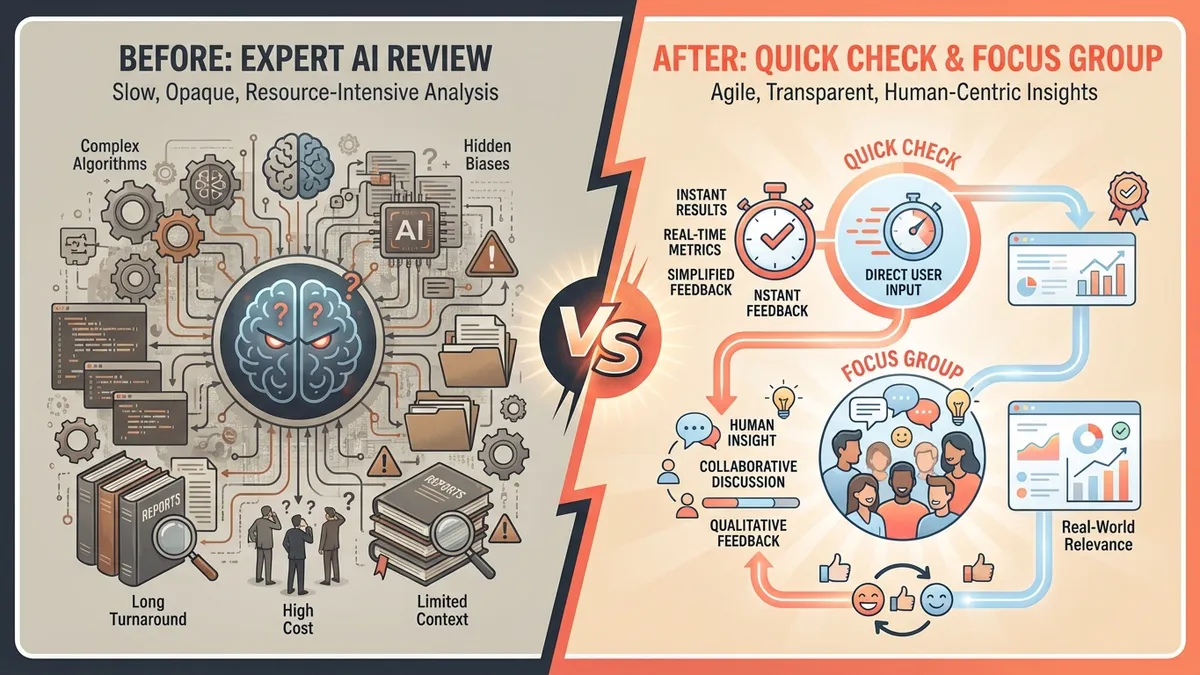
Customers told us they reach for Analysis when they need technical diagnosis—something feels off and they can’t articulate it, or they need to brief stakeholders on a piece of content’s structure and effectiveness.
| Your question | Use this |
|---|---|
| ”Is this video executing our strategy correctly?” | Analysis |
| ”What specific moments are working or failing?” | Analysis |
| ”How would different audience segments score this?” | Quick Check |
| ”What would target customers say about this?” | Focus Group |
Analysis complements the other test types rather than replacing them. Run Analysis to understand the technical structure, then Quick Check to see how different personas score it, then Focus Group to hear how they’d talk about it. Three lenses, one creative.
What Analysis won’t tell you
To be clear about limits: Analysis won’t tell you whether your specific target customer will buy. It won’t predict exact conversion rates or replace real market data. What it will do is catch the obvious issues—structural problems, pacing failures, brand presence gaps, emotional misalignments—before you spend budget learning those lessons in-market.
Think of it as the pre-flight checklist for video creative. Pilots run checklists not because they expect to find problems every time, but because catching one problem before takeoff is worth more than discovering it at altitude. Video marketers can now have a pre-flight check on creative—not a guarantee of performance, but a structured review that catches fixable issues early.
See it in action
Want to see what an Analysis report looks like for your creative? Book a demo and we’ll walk you through the platform with your own content. The report format is designed to be actionable: summary you can forward to stakeholders, recommendations you can prioritize, and evidence you can point to when someone asks “but why?”
Explore more sample reports to see how Analysis works across different creative types, or book a demo to test it on your own content.