Replicating a Peer-Reviewed Food Study — Phase 2: 22 Synthetic Personas Matched 9 of 10 Sub-Themes, and Surfaced 6 Frames the Paper Didn't Document
Content analyzed: Kumar, Kulkarni & Rathi (2022) — Evolving Food Choices Among the Urban Indian Middle-Class, Frontiers in Nutrition, PMC9001910
Key Findings
- The deep analytical pass covered 9 of Kumar's 10 Phase 2 sub-themes — 8 fully matched, 1 in adjacent form (weighted: 8.5 / 10 = 85%)
- On top of that, 6 additional frames surfaced that were not documented in the paper's analysis — including Gulf food culture, medical-KPI diet governance, and 'pure veg' marketing as caste exclusion
- Both passes independently surfaced all 6 bonus frames and the same dominant matched sub-themes — a stability signal across two runs at different depths
- The one sub-theme neither pass recovered is Advertising & media. Kumar et al. include a participant quote (P12, Mumbai) naming TV as the single largest driver of eating-habit change; our personas name YouTube, Instagram and delivery-app algorithms instead, reflecting where attention has moved
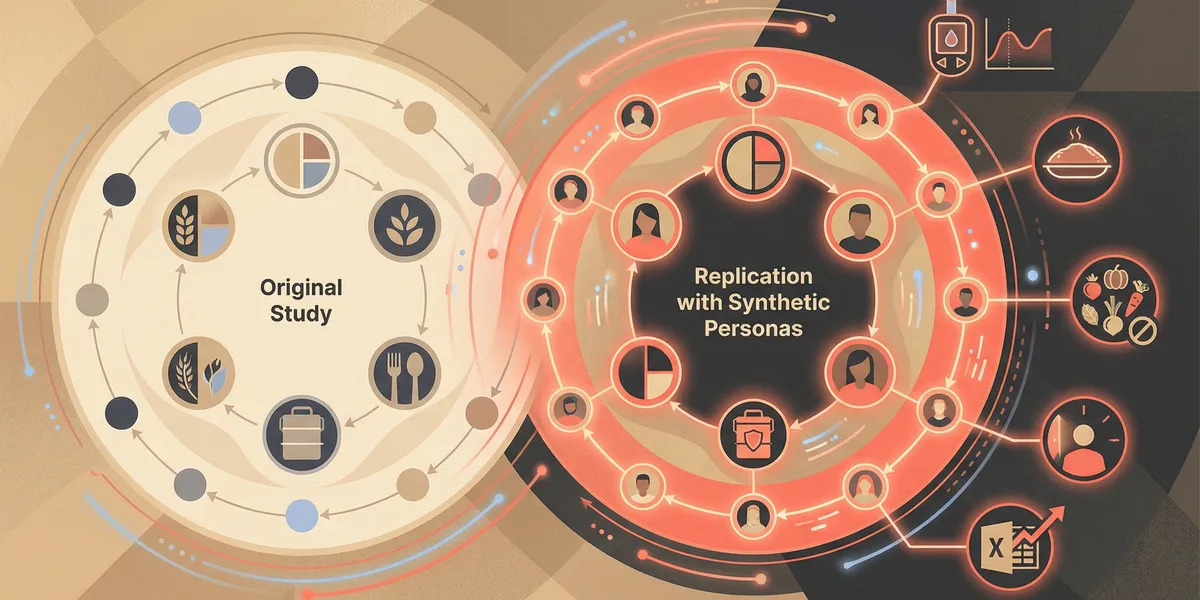
In 2022, Kumar, Kulkarni and Rathi published “Evolving Food Choices Among the Urban Indian Middle-Class” in Frontiers in Nutrition — a qualitative two-phase study. Phase 1 was a pair of focus group discussions on processed foods (covered in our separate Phase 1 replication). Phase 2 was 22 semi-structured interviews with urban middle-class Indians in Mumbai and Kochi on broader food-choice change. Phase 2’s thematic analysis produced 2 primary themes — Changing socio-cultural environment and Changing food environment — with 10 sub-themes under them.
We re-ran Phase 2’s three interview questions through 22 synthetic personas on our platform. The personas weren’t custom-built for this study — they came from our general India persona pool, selected by demographic match. The whole thing took minutes, not months.
The result: the personas covered 9 of the 10 Phase 2 sub-themes — 8 fully matched and 1 in adjacent form. In addition, they surfaced 6 frames not documented in the paper’s analysis — most of which reflect how food culture has changed between the paper’s fieldwork (not dated in the paper, but manuscript received December 2021) and ours (April 2026).
This is a validation study. The point isn’t to claim synthetic personas replace ethnography. The point is to ask a specific, falsifiable question: when you ask the same questions to a demographically matched synthetic panel, do you get the same answers a trained researcher got from real people? For this study, on this topic, in this population, the answer is: yes, and then some.
We’re a city of exhausted people who have outsourced our kitchens so we can keep working to pay for the apartments those kitchens are in. It’s a bit of a cynical loop.
— Preethi Nair, 38, Mumbai
The Original Study
Kumar et al. (2022) Phase 2 interviewed 22 middle-class Indians (13 women, 9 men, ages 40-65, all college-educated) across Mumbai and Kochi. The three open questions, verbatim from Table 2 of the paper, were:
- Describe your day-to-day eating habits.
- Have your eating habits or food choices changed since childhood?
- In general, do you see any changes in eating habits and the food environment? If so, what are the reasons for these changes?
Their thematic analysis produced 2 primary themes — Changing socio-cultural environment and Changing food environment — with 10 sub-themes under them, covering globalization and urbanization, long work days, rising incomes, decline in household cooking, food diversity, availability and accessibility, convenience, advertising and media, food as identity, and lifestyle diseases and quality of food. (International fast food chains appear as illustrative content inside the Food diversity sub-theme, not as a separately named sub-theme.)
Paper: Frontiers in Nutrition, PMC9001910
Our Replication
22 synthetic personas, picked by demographic match from our India persona pool:
- 11 from Kerala — Ernakulam, Thrissur, Palakkad, Malappuram. A mix of bank clerks, IT workers, teachers, nurses, and homemakers. Jacobite Syrian Christian, CSI Protestant, Knanaya Mar Thoma, Syro-Malabar Catholic, Mappila Muslim, Hindu SC (Parayan, Pulayan).
- 11 from Maharashtra, Rajasthan and Madhya Pradesh — Pune, Mumbai, Tonk, Bhilwara, Morena. School teachers, IT coordinators, operations managers, HR executives, a retired bank director, a QA engineer. Tamil Iyer, Tamil Brahmin, Bengali, Telugu, Marathi OBC, Navayana Buddhist, Meena tribal, Brahmin.
Ages 38-67. Income ₹20,000 to ₹95,000 per month. 15 women, 7 men. Three of the 22 personas have secondary (higher secondary certificate) schooling rather than a bachelor’s degree — a small, documented deviation from the original study’s college-educated criterion, made because the platform’s current India pool has limited college-graduate coverage in some of the demographic slices we needed to fill the 40-50 age band.
We asked each persona the three original questions in a single survey pass, with a scenario that framed them as interviewees in a food-culture research study. They answered in their own voice — using specific dish names, brand names, family members, medical conditions, and market locations.
Two independent passes
We ran the replication twice — a fast pilot pass and a deep analytical pass — to report theme stability and demonstrate the practical workflow for research replications on the platform.
Both passes used the same 22 personas, the same three questions, and the same scenario framing. Only the depth of the persona responses and the thematic synthesis varied.
| Pass | Fully matched | Partially matched | Not found | Weighted score |
|---|---|---|---|---|
| Fast pilot pass | 6 | 3 | 1 | 7.5 / 10 (75%) |
| Deep analytical pass | 8 | 1 | 1 | 8.5 / 10 (85%) |
Scoring is weighted: a full match counts as 1.0, a partial match as 0.5. A partial match means the sub-theme is present in the persona data but expressed more shallowly than in the original — articulated with less specificity, or rotated by era (e.g. 2026 cost pressure instead of rising-income expansion).
Critically, both passes independently surfaced all 6 bonus frames the paper’s analysis didn’t cover. The platform recovering the same novel observations across two passes at different depths is itself a validation signal — these aren’t artifacts of the deeper pass, they’re stable findings.
How practitioners should use this pattern: Start with a fast pilot pass to verify that your study design, persona panel, and scenario framing are directionally right. If the pilot comes back with recognizable themes, commit to the deep analytical pass for publishable results. If the pilot surfaces methodology problems — wrong demographic mix, leading questions, scenario issues — tune the parameters and re-run the pilot. Only commit to the deep pass when you are confident the inputs are right. This is the same pilot-to-full-study discipline qualitative researchers use with human participants, just compressed from months to minutes.
The results reported below — matching counts, quotes, bonus frames — come from the deep analytical pass unless otherwise noted.
What Matched the Paper’s Sub-Themes
The deep analytical pass recovered 9 of the 10 Phase 2 sub-themes.
| # | Paper’s Sub-Theme | Match | How It Showed Up in Our Panel |
|---|---|---|---|
| 1 | Globalization & Urbanization | ✓ Full | Migration, regional dish adoption, Gulf-returnee food habits, Tamil/Malayali diaspora maintaining matta rice as identity anchor |
| 2 | Long work days & sedentary lifestyles | ✓ Full | Reframed sharper by our personas as “time poverty” — the 90-minute commute killing the tiffin habit |
| 3 | Rising income levels | ~ Partial | Personas see income as tension — rising yet price-sensitive; food inflation as a felt constraint, not a historical success story |
| 4 | Decline in household cooking | ✓ Full | Ready-made ginger-garlic paste, MTR sambar powder, frozen grated coconut, “I’ve made peace with it” |
| 5 | Food diversity (incl. international fast-food chains as paper’s example) | ✓ Full | Oats, quinoa, avocado toast, pasta, peri-peri chicken, Korean noodles from YouTube. International chains (KFC, McDonald’s, Domino’s) appear as parental observations of children’s requests rather than as direct youth-hangout experience |
| 6 | Availability & accessibility | ✓ Full | Swiggy, Zomato, Zepto, BigBasket, D-Mart, Lulu Hypermarket — named specifically |
| 7 | Convenience | ✓ Full | Framed uniquely as a contradiction: “we know it’s bad for us, we still order it” |
| 8 | Advertising & media | ✗ Not found | See “What We Missed” below — shared blind spot across both passes |
| 9 | Food as identity | ✓ Full | Specific foods named: Arabic mandi and shawarma as Gulf status marker; “poke bowl” as corporate signaling |
| 10 | Lifestyle diseases & quality of food | ✓ Full | HbA1c tracking, BP monitoring, salt anxiety, pesticide distrust — the plate as “metabolic discipline” |
My daily eating habits are now dictated as much by my glucometer as they are by my appetite.
— Mathew Kuriakose, 46, Thrissur
What the Personas Surfaced That the Paper Didn’t Document
These are the six frames that surfaced in our replication but weren’t documented in the 2022 paper’s analysis. Most reflect changes in Indian urban food culture between the paper’s fieldwork (not dated in the paper; manuscript received December 2021) and April 2026, when we ran the replication.
1. Gulf food culture as a status signal
Kerala personas with Gulf connections described Arabic cuisine — mandi, alfaham, shawarma, kuzhimanthi — as a middle-class arrival marker. This phenomenon is now visible on any main road in central Kerala, but the 2022 paper doesn’t document it.
“If you walk down the main road now, you see more Kuzhimanthi and Alfaham restaurants than traditional tea shops.” — Fathima Noushad, 48, Tirur, Kerala
“My husband, Abdulla, has been in Dubai for eleven years, and when he comes home, he wants Alfaham or Shawarma because that’s what he’s used to there.” — Naseema Abdulla, 41, Thrissur, Kerala
2. Diet as medical-KPI governance
The paper mentions lifestyle diseases. Our personas went further: they described their plates as managed by specific medical metrics — HbA1c, blood pressure, cholesterol numbers — with the precision of a spreadsheet.
“My day is structured around my health KPIs, specifically my blood sugar levels.” — Nalini Venkataraman, 67, Mumbai
“My daily eating habits are now dictated as much by my glucometer as they are by my appetite.” — Mathew Kuriakose, 46, Thrissur
3. The tiffin as financial and health bastion
The steel tiffin — a dabba of home-cooked food carried to work — came up repeatedly as a deliberate act of resistance, not a nostalgic habit. It’s both a household budget strategy and a health strategy.
“I rarely eat at the office cafeteria; a single meal there can cost 150 to 200 rupees, which is a waste when I can bring better food from home for a fraction of the price.” — Meghana Venkateswaran, 47, Pune
“In our sector, eating in the canteen is an option, but I prefer Sunita’s cooking — it’s safer for my BP and much more economical.” — Rajendra Patil, 47, Pune
4. “Pure veg” marketing as caste exclusion
This was the most pointed finding the original paper did not touch. One Navayana Buddhist persona in Pune identified “pure veg” marketing and organic branding in urban residential complexes as a mechanism of caste-based social exclusion.
“In the private sector, what you eat and how you speak about it is often used to judge your ‘culture fit.’ You’ll see managers bonding over specific vegetarian delicacies from their shared college backgrounds, effectively excluding anyone who doesn’t share those tastes.” — Vandana Sarate, 38, Pune, Navayana Buddhist
5. Eating alone as liberation (the outlier voice)
The paper implicitly assumes communal eating is positive and its decline is a loss. One Bengali persona in Pune reframed the same decline as freedom from patriarchal food performance — a genuine counter-voice that the thematic consensus of the original study does not capture.
“Growing up in Kolkata, meals were a theater production for the extended family. There was zero privacy; what you ate was a public statement of your ‘status’ as a good daughter or wife-in-training. I hated it.” — Sohini Chakraborty, 38, Pune
6. Food inflation as a 2026 stressor
Several personas named specific 2026 price increases — coriander, fish, vegetables — as a felt constraint on daily eating. Kumar’s paper frames rising income as an enabler of new food behaviors; our personas frame 2026 food inflation as a squeeze on those same behaviors.
“I track my grocery spending on an Excel sheet every Sunday evening.” — Meghana Venkateswaran, 47, Pune
“I try to keep our food simple because every rupee I save on fancy groceries or eating out is another ₹2,000 I can put into my gold savings scheme.” — Bindhu Parayan, 38, Palakkad
What We Missed (And Why)
Honesty about where the personas fell short is the whole point of a validation study. Of the 10 Phase 2 sub-themes in the paper, our deep analytical pass fully missed one and partially recovered one. Each gap is explainable. (A third observation — international fast food chains appearing only as parental observations rather than as direct youth-hangout consumption — is already noted inside the Food diversity row above, since the paper treats chains as illustrative content within Food diversity rather than as a separate sub-theme.)
Partial — Rising Income Levels. The paper’s core observation was historical: middle-class Indians remembering when they could not afford certain foods, and new incomes enabling new behaviors. Our personas don’t narrate rising income as a causal driver. Instead they describe food inflation in 2026 as a felt constraint on daily life — the inverse framing. The sub-theme is present but rotated ninety degrees from the paper’s version. An earlier-cohort sample would have told the paper’s version; a 2026 cohort tells a different story about the same underlying economic reality.
Not found — Advertising & Media. Kumar et al. include a participant quote from P12 (Mumbai male) — “TV advertisements are undoubtedly the biggest and single largest factor responsible for change in eating habits” — and contextualize it within existing research on child-centric advertising rather than as their own causal finding. Our personas never named TV advertising. But they did name YouTube cooking videos, Instagram food posts, Swiggy’s algorithmic recommendations, and LinkedIn food signaling. The underlying phenomenon — media shaping food desire — is present. The specific channel (TV) is not, because the attention has moved. A pre-streaming-era cohort would likely have named TV as the paper’s P12 did.
Neither pass caught the Advertising & Media sub-theme. Rising Income was present as a partial match in both passes, which makes it a stable (if shallow) sub-theme across runs. None of these gaps is a failure of the method to recover sub-themes that were present in the data we asked for. They’re reminders that a validation study has to match not just demography but era.
Methodology
| Dimension | Original Study | Our Replication |
|---|---|---|
| Participants | 22 real people | 22 synthetic personas |
| Fieldwork date | Not stated in paper (manuscript received Dec 2021) | April 2026 |
| Geography | Mumbai + Kochi only | Kerala + Maharashtra + Rajasthan + Madhya Pradesh |
| Age range | 40-65 | 38-67 |
| Gender | 13F + 9M | 15F + 7M |
| Education | All college graduates | 19 college graduates + 3 with secondary education |
| Method | Phase 1: 2 focus groups on processed foods (4 anchor questions). Phase 2: 22 semi-structured interviews on food-choice change (3 anchor questions). This replication targets Phase 2 only. | Phase 2’s 3 anchor questions, two independent passes (fast pilot + deep analytical) per persona |
| Language | Phase II interviews: English or Malayalam by participant preference; Malayalam transcripts translated to English for analysis | English (all responses) |
| Analysis | Manual thematic coding with NVivo 12 | Platform thematic synthesis |
| Time to results | Months | Minutes |
The panel was broader than the original’s Mumbai + Kochi frame. That’s a deliberate choice: it let us test whether the paper’s themes generalize beyond its specific cities, and it surfaced regional contrasts (bajra/jowar versus matta rice versus pithla-bhakri) that don’t exist in a two-city sample.
We do not claim synthetic personas replace ethnography. We claim that on a well-studied topic, with a demographically matched panel, a platform survey can recover the themes a trained researcher would find — and sometimes see things the original missed because the world changed.
Limits
- No real participants as ground truth. This replication compares to a published paper, not to fresh interviews with the same personas’ real-world equivalents.
- 22 personas is a small panel. The original study chose it. We matched it deliberately, but larger panels would give narrower uncertainty on which themes are stable.
- Three of our personas use secondary education instead of the college degree the original study required. We documented this and don’t think it materially affected the themes, but it’s a deviation.
- Temporal gap. The biggest single source of divergence. The paper’s fieldwork year isn’t stated (manuscript received December 2021); ours ran April 2026. Those are genuinely different food environments in urban India. The replication tells you what’s true now — not what was true when the paper was written.
- We only replicated the three-question interview protocol from Phase II. Kumar et al. (2022) had two phases: 2 focus group discussions (Phase I) and 22 semi-structured face-to-face interviews (Phase II). The paper describes Phase II as “semi-structured” but the documented protocol consists of exactly three open-ended questions (the same Q1-Q3 we used), and the Data Collection section does not describe any probing or follow-up questions beyond those three anchors. Our replication matches this documented protocol: each persona answered the three questions in a single structured pass, without conversational follow-up. A future replication could extend to Phase I focus groups as well.
- Language handling is consistent with the original. Kumar et al. conducted Phase II interviews in English or Malayalam based on each participant’s preference, transcribed them verbatim, and translated Malayalam transcripts to English for NVivo 12 thematic analysis. Our personas responded in English directly. The thematic analysis in both studies operates on English-coded text, so this is a consistent methodology — but it does mean Malayalam-native phrasings were never present in our pipeline.
What This Means
For researchers: a demographically matched synthetic panel recovered the themes of a published qualitative study at low time and cost, and the themes it didn’t recover have structural explanations. That’s a usable baseline for thinking about which kinds of research questions synthetic personas can answer and which they can’t.
For practitioners — marketers, product teams, agency planners — the implication is more direct: if you’re studying a population whose real-world behavior is already documented somewhere (census data, prior research, brand trackers), you can get directional thematic insight on three questions in an hour instead of three months. Not as a replacement for real fieldwork, but as the thing you do before deciding what fieldwork is worth doing.
If you want to test this on a question you care about, book a demo or explore more evidence.